Our Services
At Sherwood Allen Verification (SAV), we deliver independent, science-based assurance across three core pillars — climate strategy, sustainable finance, and verified climate action.
Our services support organizations in meeting regulatory requirements, strengthening carbon governance, validating T-VER and other climate projects, verifying GHG inventories under ISO and CFO frameworks, and accessing sustainable finance with investor-grade credibility.
Through rigorous, internationally aligned verification, we help ensure that climate commitments are not only declared — but demonstrably credible, measurable, and defensible.

Core Verification Services
01ISO 14064-1 & CFOGreenhouse Gases Standard
What Are ISO 14064-1 & CFO?
ISO 14064-1 is an internationally recognized standard under the ISO 14060 family that establishes principles and requirements for the quantification, monitoring, and reporting of greenhouse gas (GHG) emissions at the organizational level.
Thailand’s Carbon Footprint for Organization (CFO) program, administered by the Thailand Greenhouse Gas Management Organization (TGO), applies internationally aligned GHG accounting principles within the national regulatory and reporting context.
Overview
Organizational GHG Verification (ISO 14064-1 & CFO)
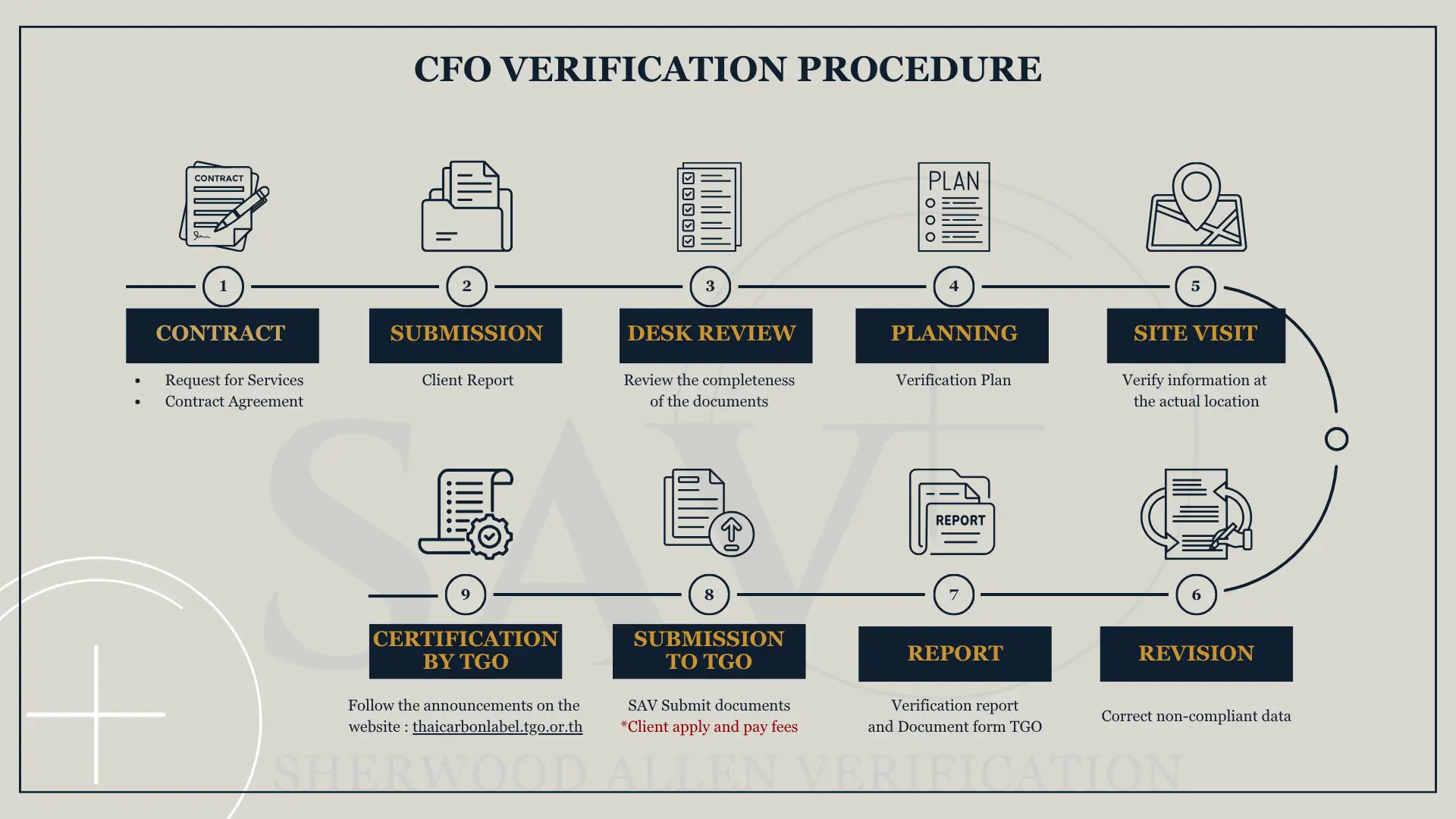
SAV provides independent third-party verification of organizational GHG inventories under both ISO 14064-1 and the CFO program.
Our verification approach ensures:
- Accuracy, completeness, and consistency of Scope 1–3 emissions data
- Proper boundary setting and emission factor application
- Alignment with international best practices and national requirements
- Compliance with CFO submission and TGO registration processes
- Investor- and regulator-ready climate disclosures
Whether for international reporting, CFO registration, sustainability reporting, science-based targets, or preparation for evolving regulatory frameworks, SAV delivers rigorous, evidence-based assurance that strengthens confidence in your organizational climate data.

Scope
1. General Manufacturing Industries
2. Metals Production
3. Aluminum Production
4. Mining and Mineral Production
5. Carbon Capture Storage
6. Transport
7. Waste handling and disposal
8. Agriculture, Forestry and Other Land Use (AFOLU)
9. General Services
1. General Manufacturing Industries
2. Metals Production
3. Aluminum Production
4. Mining and Mineral Production
5. Carbon Capture Storage
6. Transport
7. Waste handling and disposal
8. Agriculture, Forestry and Other Land Use (AFOLU)
9. General Services
02ISO 14064-2 & T-VERGHG Projects and T-VER
What Are ISO 14064-2 and T-VER?
ISO 14064-2 is part of the ISO 14060 family developed by the International Organization for Standardization (ISO). It provides internationally recognized principles and requirements for quantifying, monitoring, and reporting greenhouse gas (GHG) emission reductions or removal enhancements at the project level.
The standard establishes requirements for:
- Project design and boundary definition
- Baseline scenario determination
- Additionality assessment
- Monitoring methodology and data management
- Quantification and reporting of GHG reductions or removals
Thailand’s T-VER (Thailand Voluntary Emission Reduction Program), administered by TGO, applies internationally aligned carbon accounting principles within the national voluntary carbon market. T-VER projects — including Standard and Premium T-VER — follow structured methodological requirements for emission reductions and carbon removals, particularly in forestry, agriculture, renewable energy, and waste management sectors.
ISO 14064-2 provides the international framework, while T-VER operationalizes these principles within Thailand’s regulatory and carbon market context.
Overview
GHG Project Validation & Verification (ISO 14064-2 & T-VER)
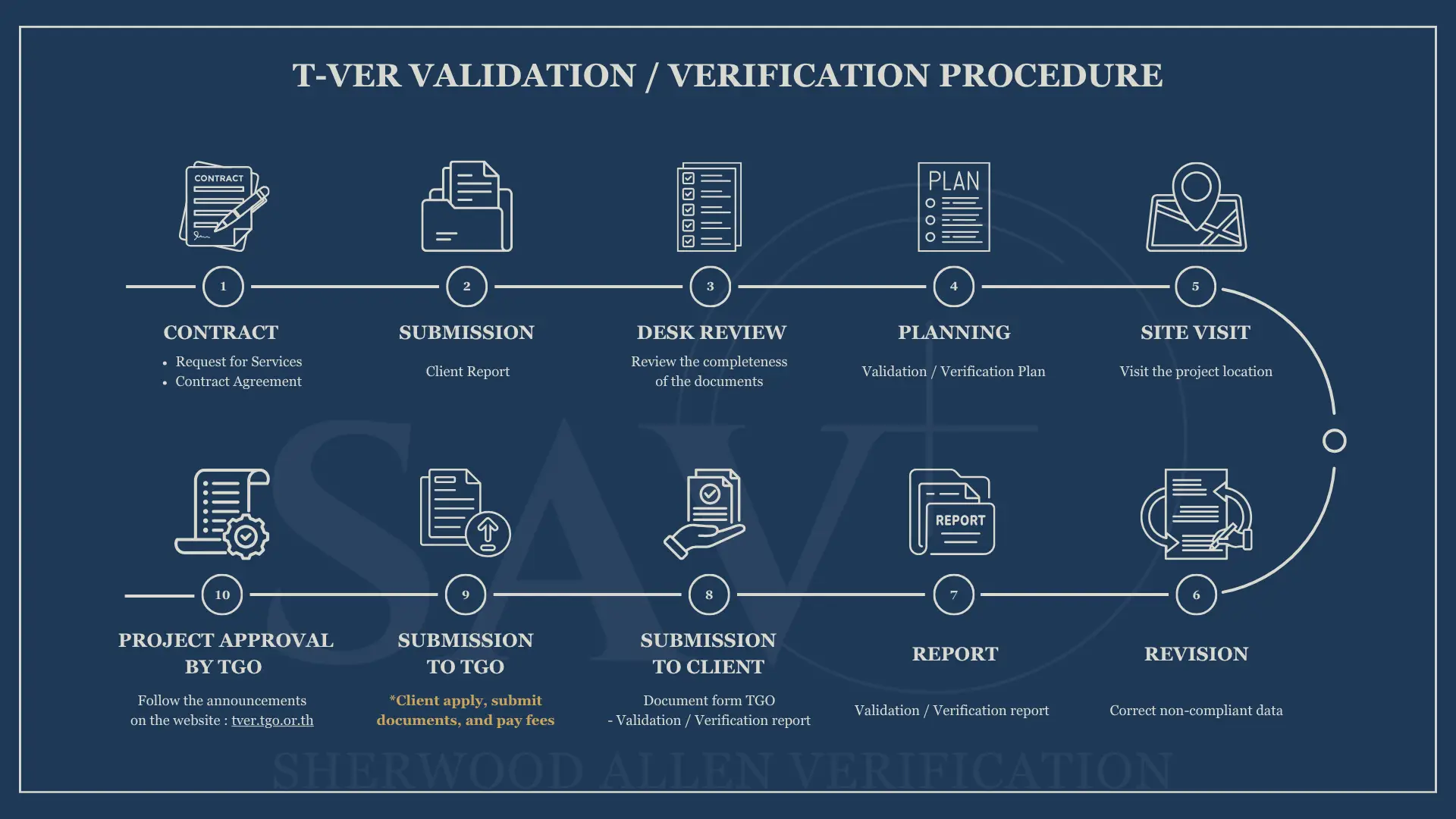
SAV provides independent validation and verification services for climate mitigation and carbon removal projects under ISO 14064-2 and T-VER (Standard & Premium).
Our project assurance services ensure:
- Robust and defensible baseline setting
- Demonstrated additionality in accordance with methodological requirements
- Transparent monitoring plans and data integrity
- Proper quantification of emission reductions or carbon removals
- Alignment with TGO requirements and applicable national regulations
- Credible issuance readiness for carbon credits
With deep expertise in forestry and agriculture carbon projects — including complex removal and buffer management structures — SAV delivers technically rigorous, internationally aligned assurance that strengthens the environmental integrity and market credibility of your climate projects.


Scope
- Transport
- Waste handling and disposal
- Afforestation and Reforestation
- Agriculture
03ISO 14067 & CFPProduct Carbon Footprint
What is ISO14067 & CFP?
ISO14067 specifies principles, requirements, and guidelines for the quantification and communication of the carbon footprint of products. It is based on Life Cycle Assessment (LCA) methods defined in ISO14040 and ISO14044. The standard enables organizations to assess the total GHG emissions from raw material acquisition, production, distribution, use, and disposal. ISO14067 is increasingly used for compliance with CBAM, eco-labeling, sustainable procurement, and product-level climate declarations.
Overview
Product Carbon Footprint (ISO14067) & Carbon Footprint of products (CFP)
In a world of carbon transparency, your product’s footprint matters. SAV verifies product-level GHG emissions across the life cycle, in accordance with ISO14067. Whether for CBAM compliance, green labeling, or CFO registration — we help manufacturers deliver verified climate data with confidence.
04ISO 14068-1Verification (Carbon Neutrality & Adaptation)
What is ISO14068-1?
ISO 14068-1 is an international standard that establishes principles, requirements, and guidance for achieving and demonstrating carbon neutrality at the organizational, product, or project level.
The standard requires:
- Comprehensive quantification of GHG emissions
- Clear reduction strategies aligned with science-based principles
- Transparent and credible use of carbon credits or offsets
- Robust governance, documentation, and public claims management
- Optional integration of climate adaptation considerations to address physical climate risks
ISO 14068-1 strengthens the integrity of carbon neutrality claims by ensuring reductions are prioritized before offsetting, and that any residual emissions are addressed through credible, high-quality carbon mechanisms. It provides a structured framework to prevent greenwashing and enhance stakeholder confidence.
Overview
Carbon Neutrality & Climate Adaptation Verification (ISO 14068-1)
Carbon neutrality is not merely the purchase of offsets — it requires demonstrable emissions reductions, transparent accounting, and defensible claims.
SAV provides independent third-party verification of carbon neutrality assertions under ISO 14068-1.
Our verification process ensures:
- Accurate quantification of organizational or product-level emissions
- Proper prioritization of reduction measures
- Transparent and justified use of carbon credits
- Alignment with ISO standards, CFO requirements, and relevant TGO frameworks
- Credible communication of carbon neutrality claims
Through rigorous, evidence-based assurance, we help organizations make carbon neutrality declarations that are measurable, compliant, and resilient to regulatory and investor scrutiny.
05ISO 14040/14044Life Cycle Assessment (LCA)
What is LCA?
Life Cycle Assessment (LCA) is an internationally standardized methodology under ISO 14040 and ISO 14044 that evaluates the environmental impacts of products, processes, or services throughout their entire life cycle. This includes every stage from raw material extraction, production, and distribution to use, end-of-life treatment, and potential recycling (cradle-to-grave). LCA provides a science-based foundation for decision- making in eco-design, product carbon footprinting, and sustainability strategies. It is also used as a reference in related standards such as ISO 14067 (Carbon Footprint of Products) and the EU Product Environmental Footprint (PEF).
Overview
Life Cycle Assessment (LCA)
Strengthen the credibility of your sustainability strategies with a comprehensive life cycle perspective. SAV supports organizations in applying ISO 14040/14044 standards to identify environmental hot spots, improve product and process design.
06ICMA SPOSecond Party Opinion (SPO)
What is a Second Party Opinion (SPO)?
A Second Party Opinion (SPO) is an independent assessment of a sustainable finance framework, including Green Bonds, Social Bonds, Sustainability Bonds, and Sustainability-Linked Bonds (SLBs).
An SPO evaluates whether the issuer’s framework aligns with internationally recognized principles, including:
- ICMA Green Bond Principles (GBP)
- ICMA Social Bond Principles (SBP)
- ICMA Sustainability Bond Guidelines (SBG)
- ICMA Sustainability-Linked Bond Principles (SLBP)
Where relevant, alignment with ASEAN and Thai Taxonomies, as well as Climate Bonds Initiative (CBI) criteria, may also be assessed.
SPOs play a critical role in strengthening investor confidence, supporting regulatory disclosure, mitigating greenwashing risk, and enhancing ESG transparency in capital markets.
Overview
Second Party Opinion (SPO) for Sustainable Finance
SAV provides independent and technically rigorous Second Party Opinions for issuers seeking to access sustainable capital markets.
Our SPO services support:
- Green, Social, and Sustainability Bond frameworks
- Sustainability-Linked Bond (SLB) structures
- KPI and Sustainability Performance Target (SPT) assessment
- Taxonomy alignment analysis (ASEAN / Thai / relevant international frameworks)
Through structured evaluation and transparent reporting, we help issuers demonstrate credibility, strengthen investor trust, and align with global sustainable finance expectations.
07CUSTOMIZED SERVICESTailored Sustainability & Verification Solutions
What are Customized Sustainability Services?
Customized services refer to tailored sustainability and verification solutions developed to meet specific organizational needs beyond standard frameworks. These include ESG system design, , . Customized services are ideal for businesses requiring flexible, strategic, and sector-specific climate alignment.
Overview
Customized Sustainability Assessment Program
Not all sustainability journeys fit into a standard framework. At SAV, we provide tailored solutions to help clients design, prepare, or verify unique environmental and climate strategies — whether for internal ESG systems, international investor reporting, or custom sectoral needs.
01
Client Engagement & Scoping
Engage with clients to understand their sustainability objectives, operational context, and compliance needs.
02
Methodology Design
Develop a tailored roadmap, select verification pathways, and align methodologies with international and local benchmarks.
03
Assessment
Conduct on-site or remote evaluations, data collection, and internal audits to ensure readiness and accuracy.
04
Reporting & Recommendations
Deliver comprehensive reports, visual summaries, and strategic insights to support stakeholder communication and continuous improvement.